

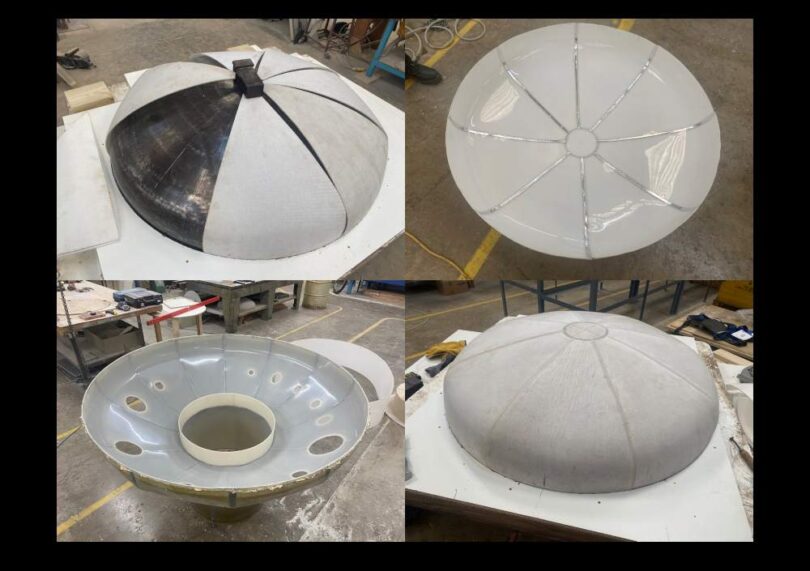
The consequences of pressure vessel failure in the pharmaceutical industry extend far beyond immediate safety concerns, according to Arthur Scott-Bowden at ERG Hygrade.
The financial losses caused by process interruption and batch loss can be very unpalatable, and that’s before carefully disposing of contaminated, with all the regulatory reporting and potential manufacturing suspension that goes with it. Then there’s the revalidation costs and timeline impacts, not to mention all the reputational and commercial implications…..
As pharmaceutical processes become increasingly demanding and regulatory expectations continue to evolve, the importance of robust, reliable pressure vessel design will only increase. Dished end technology represents a clear advancement in engineering practice, delivering quantifiable improvements in structural performance, fabrication quality, and operational confidence.
For critical applications where process integrity, personnel safety, and regulatory compliance are paramount, dished ends should be considered the preferred engineering solution. This approach aligns with both established design principles and emerging best practice for high-specification pharmaceutical applications.
Design decisions at the vessel junction level, specifically the method of joining cylindrical shell sections to domed or conical end closures, are of paramount importance to structural performance, fatigue life, and maintenance requirements.
The use of dished ends eliminates abrupt geometric transitions by employing smooth, continuous radius sections between the cylindrical shell and end closures. This approach replaces the cone-to-cylinder discontinuity with a controlled radial profile, typically matched to a domed or torispherical head geometry.
The radial transition distributes loads more uniformly across the junction, reducing peak stresses and improving fatigue resistance.
Dished end design is a more robust fabrication in several respects. The smoother geometry allows for:
- More consistent laminate deposition
- Reduced dependence on individual operator skill
- Easier inspection and non-destructive testing access
- Improved reproducibility across multiple vessels
- Enhanced integration with automated or semi-automated fabrication processes
From a quality assurance perspective, radial joints reduce the number of critical control points requiring intensive inspection, thereby improving overall manufacturing consistency.
The continuous radial transition geometry provides significant advantages for plastic liner systems. The absence of sharp transitions or conical sections reduces mechanical stress on the liner during installation, thermal expansion, and pressurisation. Liner bond integrity is more readily achieved and maintained, reducing the risk of delamination or chemical ingress to the structural laminate.
Whilst dished ends offer clear structural advantages, their adoption introduces fabrication considerations. Thermoplastic-lined dished ends require a greater number of welds and longer construction time compared to conical designs, increasing labour costs. The upfront investment in forming tooling represents an additional capital consideration, particularly for non-standard vessel diameters. Material efficiency is also a factor: the thermoplastic liner sheet must be oversized to account for thermal shrinkage during the forming process, and subsequent trimming by the fabricator generates offcut waste. These costs should be weighed against the long-term performance and reliability benefits that dished end designs provide.
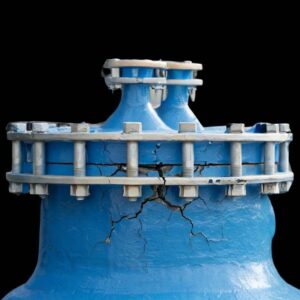
Structural damage at a vessel junction illustrates the potential impact of stress concentration and cyclic loading on pressure equipment performance.
Pharmaceutical reactor and scrubber vessels frequently experience cyclic loading, batch processes, temperature swings, start-stop operation, and periodic cleaning cycles. Under such conditions, fatigue performance becomes a key design consideration.
Domed vessels with radial transitions exhibit superior fatigue performance due to reduced stress concentration factors and more uniform load distribution. This translates directly to extended service life and reduced risk of in-service failure.
In many pharmaceutical installations, reactor off-gases are routed directly to scrubbing systems without intermediate buffering. This creates operational interdependence: scrubber unavailability forces reactor shut down, and vice-versa. Designing both vessels to equivalent standards of structural integrity and reliability is therefore essential for maintaining overall system availability and production continuity.
Overall, one should look to specify radial transitions with domed end closures for new pharmaceutical reactor and scrubber vessel designs.
It is also best to review existing coned vessels for potential upgrade or replacement, particularly those experiencing cyclic loading or approaching end of design life.
Always ensure that fabrication partners possess demonstrated competence in dished end and radius knuckle technology and thermoplastic liner integration.
Implement comprehensive quality assurance protocols covering laminate inspection, liner bond testing, and pressure testing.
Maintain detailed documentation and traceability for regulatory validation and lifecycle management.
To download the whole White Paper, click here.
Image courtesy of ERG Hygrade.