
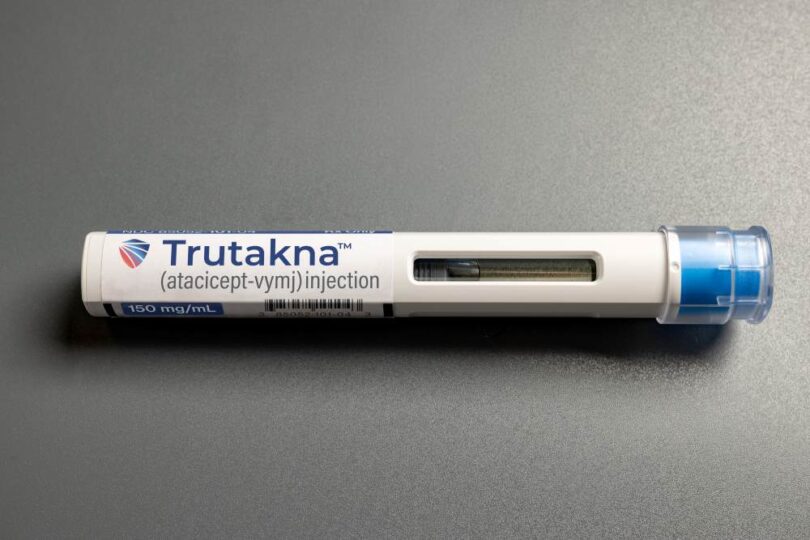
The US Food and Drug Administration has granted Trutakna accelerated approval to reduce proteinuria in adults with primary IgA nephropathy at risk of disease progression. Vera Therapeutics’ drug is the first to inhibit both BAFF and APRIL.
The decision, announced on 7 July 2026, rests on a surrogate endpoint. It has not been established whether Trutakna (atacicept-vymj) slows the long-term decline in kidney function.
That distinction sits at the centre of the approval, and the company states it plainly.
What the Trutakna accelerated approval actually covers
The indication is narrow and specific: reducing proteinuria in adults with primary IgA nephropathy at risk for disease progression. Proteinuria is the presence of excess protein in the urine. It is recognised as a surrogate marker for reduced risk of kidney function decline, not a measure of that decline itself.
Under the FDA’s accelerated approval pathway, drugs for serious conditions that fill an unmet need may be approved on such a surrogate. The trade-off is that continued approval may be contingent on a confirmatory trial verifying clinical benefit.
Trutakna is a soluble recombinant fusion protein containing the human TACI receptor. It binds two cytokines, B-cell activating factor (BAFF) and A proliferation-inducing ligand (APRIL). Both activate B cells to produce the autoantigen Gd-IgA1 and its autoantibodies, which form immune complexes that deposit in the kidneys.
The dose is 150 mg, self-administered at home once weekly by subcutaneous autoinjector.
Inside the ORIGIN 3 interim analysis
ORIGIN 3 is an ongoing global, multicentre, randomised, double-blind, placebo-controlled Phase 3 trial. Participants were randomised one-to-one to Trutakna or placebo.
The primary efficacy endpoint of the prespecified 36-week interim analysis was change in 24-hour urine-protein-to-creatinine ratio against placebo, measured in the first 203 participants to receive at least one dose. Patients on Trutakna achieved a 46% reduction from baseline, and a 42% reduction compared with placebo (p<0.0001).
Importantly, efficacy was consistent across prespecified subgroups including age, sex, race, region, baseline proteinuria, baseline eGFR and baseline SGLT2 inhibitor use. Patients also showed a 68% reduction in galactose-deficient IgA1, though this was a secondary endpoint reported without multiplicity adjustment and is observational.
“TRUTAKNA offers patients and their nephrologists an exciting new treatment advancement that inhibits both BAFF and APRIL, the two key cytokines that act on B cells, which are at the source of IgAN pathophysiology,” said Richard Lafayette, Professor of Medicine and Director of the Glomerular Disease Center at Stanford University Medical Center, and a principal investigator in the ORIGIN programme.
Safety findings and prescribing warnings
Safety was assessed in 428 patients who received at least one dose of Trutakna or placebo. The most common adverse reactions in the Trutakna and placebo groups respectively were infections (32% versus 28%) and local administration reactions (30% versus 5%).
The most common infection was upper respiratory tract infection (12% versus 9%). Injection site reaction occurred in 19% of Trutakna patients against 2% on placebo. Vera reports no serious, severe or opportunistic infections, and no hypogammaglobulinaemia, in treated patients.
However, the label carries warnings. Trutakna suppresses the immune system by reducing antibody production, which may raise infection risk, and patients should be assessed for active infection before starting. It may also interfere with vaccine response; live vaccines are not recommended within 30 days of initiation or during treatment. Safety and effectiveness in paediatric patients have not been established.
Why the Q3 2026 kidney function readout matters
IgA nephropathy is a progressive, immune-mediated kidney disease and a leading cause of chronic kidney disease and kidney failure. Vera estimates around 160,000 patients are affected in the US. Diagnosis most often occurs between the ages of 30 and 40, and at least half of patients may progress to kidney failure or death within 10 to 20 years.
ORIGIN 3 continues in a placebo-controlled, blinded manner to evaluate change in estimated glomerular filtration rate, the direct measure of kidney function. Results are anticipated in the third quarter of 2026.
As a result, that readout — not this approval — is the decisive moment. Should it fail to verify clinical benefit, the FDA may withdraw approval or change the labelled indication.
“The approval of TRUTAKNA as the first and only BAFF and APRIL inhibitor for IgAN marks an important milestone and we believe it has the potential to meaningfully transform the treatment landscape,” said Marshall Fordyce, Founder and Chief Executive of Vera Therapeutics.
Meanwhile, the Trutakna accelerated approval adds a mechanism to a field that has moved quickly. For related coverage of B-cell targeted therapies in autoimmune disease, see the Life Sciences Global News report on Novartis ianalumab receiving FDA Breakthrough Therapy designation. Full details of the decision are available in the Vera Therapeutics announcement, with the Phase 3 data published in the New England Journal of Medicine and the trial registered as NCT04716231.