


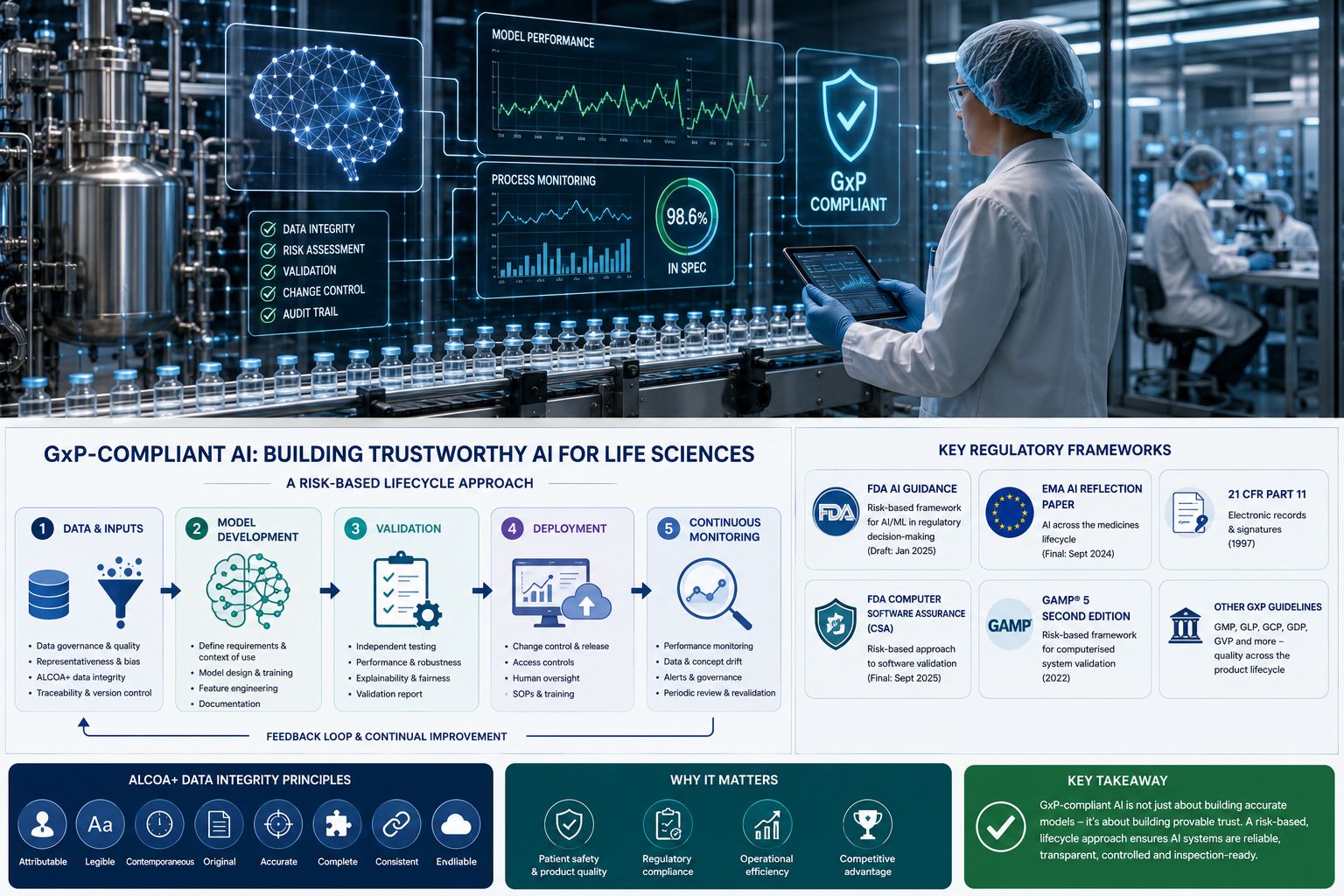
GxP-compliant AI is artificial intelligence built, validated and monitored to meet the “Good Practice” (GxP) quality regulations that govern drug development and manufacturing. In regulated life sciences, an AI tool cannot simply work — companies must be able to prove it is reliable, transparent, controlled and fit for its specific purpose, using a documented, risk-based approach that satisfies authorities such as the FDA and EMA.
Who should read this? This guide is for quality and regulatory professionals, validation and CSV/CSA engineers, data scientists and MLOps teams in pharma and biotech, manufacturing and QA leaders, and technology vendors selling AI into regulated life sciences.
AI is spreading rapidly through drug discovery, clinical development and manufacturing — but life sciences is one of the most heavily regulated industries on earth. The gap between “our model works in the lab” and “our model is trusted in a regulatory submission” is where GxP-compliant AI lives. This guide explains what GxP means, why AI needs a different kind of validation, the frameworks that apply, and how leaders can deploy AI that will withstand an inspection.
Quick Navigation
- What is GxP-compliant AI?
- What does “GxP” mean?
- Why AI needs a different kind of validation
- How to validate AI: the model lifecycle
- Key regulations and frameworks
- CSV vs CSA vs AI assurance
- Business impact and industry implications
- Challenges and opportunities
- Future Outlook & LSGN Perspective
- FAQs
At a Glance: Key Statistics
- 1997 — the year the FDA’s 21 CFR Part 11 rule established requirements for electronic records and signatures, still foundational today.
- 2022 — publication of GAMP 5 Second Edition, the industry’s leading risk-based computerised-system validation framework.
- September 2024 — the EMA finalised its reflection paper on AI across the medicines lifecycle.
- January 2025 — the FDA’s first draft guidance on AI to support regulatory decisions, with a risk-based credibility framework (final expected 2026).
- September 2025 — the FDA finalised its Computer Software Assurance (CSA) guidance, formalising a risk-based approach to software validation.
- ALCOA+ — the nine data-integrity principles (Attributable, Legible, Contemporaneous, Original, Accurate, plus Complete, Consistent, Enduring, Available) that underpin GxP records.
Figures are drawn from the regulatory sources linked above; verify before publishing.
Key takeaways
- GxP-compliant AI is AI that meets the documented, risk-based quality standards required in regulated drug development and manufacturing.
- The regulators’ consistent message: AI used in decisions about safety, efficacy or quality must be transparent, validated and fit for its context of use.
- Validation shifts from a one-time event to continuous oversight, because AI models can drift as data and conditions change.
- The FDA (CSA, AI guidance) and EMA (reflection paper) have converged on a risk-based philosophy — rigour proportionate to patient and product risk.
- Compliance is now a competitive differentiator: validated, inspection-ready AI is what enterprise buyers and regulators will trust.
What is GxP-compliant AI?
GxP-compliant AI is any machine-learning system — for target discovery, manufacturing control, quality checks, pharmacovigilance or regulatory writing — that has been developed and operated under the controls required by GxP regulations. That means documented requirements, risk assessment, validation evidence, data integrity, audit trails, access controls, change management and human oversight. The goal is not just performance but provable trustworthiness: if an inspector asks how the model was built, tested and monitored, the answer must be documented and defensible.
Key takeaway: In regulated life sciences, an AI tool is only as valuable as your ability to prove it is trustworthy.
What does “GxP” mean?
“GxP” is shorthand for the family of “Good Practice” quality regulations, where the “x” stands for the relevant discipline. The most important for AI include Good Manufacturing Practice (GMP), Good Laboratory Practice (GLP), Good Clinical Practice (GCP), Good Distribution Practice (GDP) and Good Pharmacovigilance Practice (GVP). They share a common demand: processes that affect medicine safety, quality or efficacy must be controlled, documented and reproducible — with data that meets integrity standards such as ALCOA+.
Why AI needs a different kind of validation
Traditional software is deterministic: given the same input, it produces the same output, so you can validate it once against a specification. AI — especially machine learning — is different in ways that matter deeply for GxP:
- It is probabilistic. Outputs are predictions with uncertainty, not fixed results.
- It learns from data. Model quality depends on data quality, representativeness and bias — which must themselves be controlled.
- It can drift. Performance degrades as real-world data shifts away from training data, so a model validated today may not be valid next year.
- It can be opaque. “Black box” models resist the mechanistic explanation regulators expect.
Why this matters: these properties break the assumptions behind classic computer system validation. You cannot validate a learning system once and walk away — GxP-compliant AI requires ongoing monitoring, governance and a clear plan for when the model is retrained or retired.
Key takeaway: Validation shifts from a one-time event to continuous oversight, because models drift.
How to validate AI: the model lifecycle
Modern practice applies a risk-based lifecycle rather than one-size-fits-all documentation. In outline:
- Define context of use and risk. What decision does the model inform, and what is the patient/product impact if it is wrong? Rigour scales with risk.
- Control the data. Document data sources, quality, representativeness, bias assessment and integrity (ALCOA+).
- Develop and test the model. Record the training approach, performance metrics, and independent testing against pre-defined acceptance criteria.
- Assess credibility. Demonstrate the model is fit for its specific purpose — the core of the FDA’s AI credibility framework.
- Deploy with controls. Access control, audit trails, change management, and human-in-the-loop oversight for high-impact decisions.
- Monitor continuously. Track performance and drift in production, with defined triggers for revalidation or retraining.
Key regulations and frameworks
| Framework | Body / region | What it covers |
|---|---|---|
| 21 CFR Part 11 | FDA (US) | Electronic records and signatures; audit trails, access control |
| EU GMP Annex 11 | EU / EMA | Computerised systems in GMP environments |
| GAMP 5 (2nd ed, 2022) | ISPE | Risk-based computerised system validation; includes AI/ML guidance |
| Computer Software Assurance (2025) | FDA | Risk-based assurance for production and quality-system software |
| FDA AI guidance (draft 2025) | FDA | Credibility of AI models used in regulatory decisions |
| EMA reflection paper (2024) | EMA | Risk-based AI across the medicine lifecycle |
| GMLP (2021) | FDA / MHRA / Health Canada | Good Machine Learning Practice for medical-device AI |
The throughline across all of these — reinforced by the joint FDA–EMA guiding principles published in January 2026 — is a risk-based, lifecycle approach rather than a rigid checklist.
CSV vs CSA vs AI assurance
| Dimension | Traditional CSV | Risk-based CSA (2025) | AI/ML assurance |
|---|---|---|---|
| Primary focus | Document everything | Critical thinking, risk-based testing | Model + data lifecycle |
| Effort | Heavy, uniform documentation | Effort matched to patient/product risk | Continuous, risk-weighted |
| Validation timing | One-time, before use | Risk-based, before use | Ongoing — models drift |
| Core question | Does it meet the spec? | What is the risk if it fails? | Is it still fit, fair and explainable? |
Table: the industry has moved from documentation-heavy CSV toward risk-based CSA — and AI pushes that further into continuous assurance.
Business impact and industry implications
For life sciences leaders, GxP compliance is often framed as a cost. With AI it is better understood as an enabler of scale: the organisations that can validate and monitor AI within their quality systems are the ones that can actually deploy it in production — in manufacturing, QC and regulatory workflows — rather than leaving it stuck in pilots. This is precisely the gap that specialist vendors are racing to fill. LSGN has reported on this shift, from Kivo’s “headless” GxP architecture for compliant AI in drug development to its rapid QMS modernisation case study with CRISPR Therapeutics.
Industry implication: expect quality and MLOps to converge into a single discipline, a wave of “compliant-by-design” AI platforms, and validation expertise becoming one of the scarcer, more valuable skill sets in the sector.
Challenges and opportunities
- Explainability. Opaque models are hard to defend to inspectors. Opportunity: explainable, well-documented AI becomes a genuine differentiator.
- Continuous validation. Monitoring drift and retraining under change control is operationally demanding. Opportunity: automated validation and monitoring tooling is a fast-growing market.
- Data integrity. AI multiplies the volume and complexity of GxP data. Opportunity: strong data governance compounds into a durable advantage.
- Talent. Few people fluent in both machine learning and GxP quality. Opportunity: upskilling here pays off quickly.
- Vendor risk. “AI-as-a-service” from third parties complicates accountability — an issue the FDA’s final guidance is expected to address.
Future Outlook & LSGN Perspective
The regulatory direction is now clear and converging: risk-based, lifecycle-oriented oversight of AI, harmonised across the FDA and EMA. Over the next three to five years, expect finalised FDA AI guidance, maturing “compliant-by-design” platforms, and validation increasingly automated rather than manual.
Key takeaway: In regulated life sciences, the winners will not be those with the flashiest models, but those who can deploy AI their regulators — and their own quality teams — actually trust.
LSGN Perspective: we expect “GxP-compliant AI” to stop being a specialist niche and become a baseline expectation, the way computerised-system validation did before it. The commercial edge will shift from building models to operationalising them safely at scale — pairing strong data governance with continuous, inspection-ready validation. Vendors that make compliance the default, and pharma teams that fuse quality with MLOps early, will move fastest. The organisations still treating validation as an afterthought will find their most promising AI stuck permanently in pilot purgatory.
FAQs
What does GxP stand for?
GxP is a collective term for “Good Practice” quality regulations, where “x” is the discipline — for example GMP (manufacturing), GLP (laboratory), GCP (clinical), GDP (distribution) and GVP (pharmacovigilance).
Why can’t you validate AI like normal software?
Traditional software is deterministic and can be validated once against a specification. AI is probabilistic, learns from data, and can drift over time — so it requires ongoing monitoring, data controls and governance rather than a single validation event.
What is the FDA’s position on AI in drug development?
The FDA issued draft guidance in January 2025 proposing a risk-based credibility-assessment framework for AI used to support regulatory decisions, with final guidance expected in 2026. It also finalised its risk-based Computer Software Assurance guidance in September 2025.
What is the difference between CSV and CSA?
Computer System Validation (CSV) traditionally emphasised exhaustive documentation. Computer Software Assurance (CSA), finalised by the FDA in 2025, is a risk-based approach that focuses effort where patient and product risk is highest.
What is ALCOA+?
ALCOA+ is a set of data-integrity principles — Attributable, Legible, Contemporaneous, Original, Accurate, plus Complete, Consistent, Enduring and Available — that GxP records, including AI training and output data, are expected to meet.
Does the EMA regulate AI in medicines?
The EMA finalised a reflection paper in September 2024 setting out a risk-based approach to AI across the medicine lifecycle, and in January 2026 published joint guiding principles with the FDA.
Editor’s Note. AI regulation in life sciences is evolving quickly. This guide reflects the state of the field as of 2026 — including the FDA’s finalised CSA guidance and pending AI guidance — and will be updated by the LSGN editorial team as major developments emerge.
Related Content
- Foundational read: AI in Drug Discovery and Development: The Complete Guide (pillar).
- Related: AlphaFold Explained: How AI Protein Structure Prediction Changed Drug Discovery.