
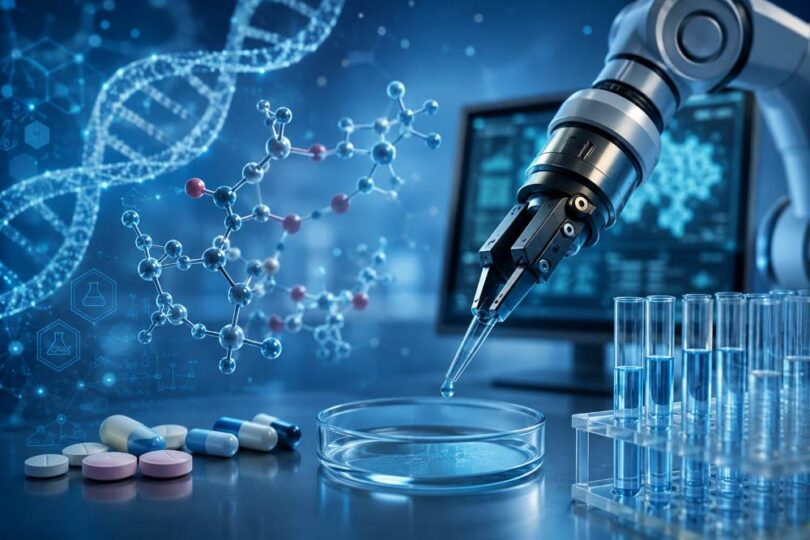
Artificial intelligence (AI) in drug discovery is the use of machine learning and related computational methods to find, design and develop new medicines faster, cheaper and with a higher probability of success. AI systems analyse vast biological and chemical datasets to identify disease targets, design candidate molecules, predict their safety and effectiveness, and streamline clinical trials — compressing steps that have traditionally taken years into weeks.
Over the past decade AI has moved from a promising research tool to a core part of how the pharmaceutical industry operates. In 2026 the field reached an inflection point: the first medicines designed with the help of AI are advancing through human clinical trials, regulators are publishing dedicated rules, and billions in investment are flowing into AI-native drug developers. This guide explains what AI in drug discovery is, how it works, who leads it, how it is regulated and where the real limits lie — and, throughout, why each development matters commercially, technically and strategically.
At a Glance: Key Statistics
- ~10–15 years — typical time to bring a new drug from discovery to market.
- ~$2.6 billion — estimated capitalised cost per approved drug, inflated largely by the cost of failure (Tufts Center for the Study of Drug Development).
- ~90% — of drug candidates entering clinical trials fail.
- ~10⁶⁰ — estimated number of possible drug-like molecules; more than the atoms in the solar system.
- 200 million+ — protein structures predicted and released by DeepMind’s AlphaFold.
- $2.1 billion — Isomorphic Labs’ 2026 funding round, the largest yet in AI drug discovery; the company targets its first AI-designed candidate in Phase 1 by end of 2026.
- 25–40% CAGR — the range at which market analysts estimate the AI-in-drug-discovery sector is growing (individual estimates vary widely).
Figures are indicative and drawn from widely cited industry sources; verify and hyperlink each before publishing.
Key takeaways
- AI in drug discovery applies machine learning, deep learning and generative models across the R&D pipeline — from target identification to clinical trial design.
- The economic case is stark: with development costing billions and ~90% of candidates failing, even modest improvements in speed or success rate are worth enormous sums.
- The biggest breakthroughs so far are in protein structure prediction (AlphaFold) and generative molecular design, which lets AI propose entirely new drug-like molecules.
- 2026 is a proof-point year: AI-first companies including Isomorphic Labs and Recursion are moving AI-designed candidates into and through clinical trials.
- Regulators are formalising the rules: the FDA’s first draft guidance (January 2025) and joint FDA–EMA principles (January 2026) signal that validated, transparent AI is now an expectation, not an option.
- AI is an accelerator, not a replacement for laboratory experiments and clinical trials — data quality, bias, validation and explainability remain real constraints.
Why drug discovery needs AI
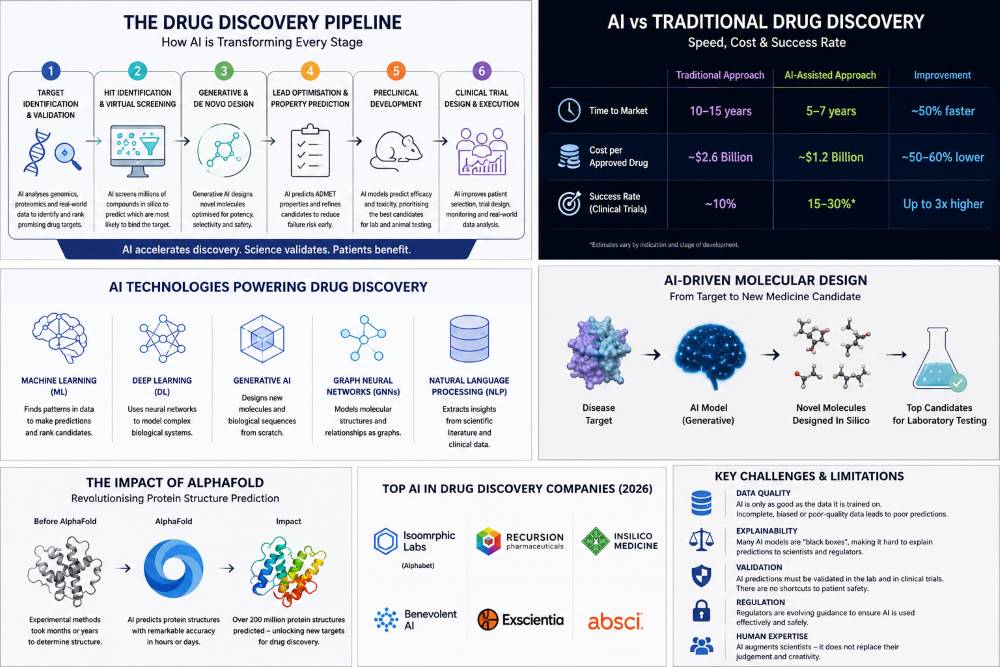
Bringing a new medicine to market is one of the slowest, most expensive and riskiest endeavours in any industry. Independent estimates put the time from discovery to approval at 10 to 15 years and the capitalised cost at around $2.6 billion per approved drug — a figure inflated largely by the cost of the roughly nine in ten candidates that fail after entering clinical trials.
The root problem is the size of the search space: the number of possible small, drug-like molecules is estimated at around 10⁶⁰. Human scientists can explore only a tiny fraction. AI’s central promise is to search that space far more intelligently — predicting which of millions of possibilities are worth making and testing, and flagging likely failures early, before a company spends hundreds of millions on them.
Why this matters: in an industry where the economics are dominated by failure, AI’s value is less about invention for its own sake and more about risk reduction — killing bad candidates sooner and raising the odds that the survivors succeed. That reframing is what has moved AI from a laboratory curiosity to a boardroom priority.
How AI works across the drug discovery pipeline
AI is not a single tool but a set of techniques applied at every stage of research and development.
1. Target identification and validation
AI models trained on genomics, proteomics, scientific literature and real-world patient data surface novel target–disease links humans might miss, and rank targets by how “druggable” and disease-relevant they are.
2. Hit identification and virtual screening
Instead of physically testing millions of compounds, AI-driven virtual screening predicts which molecules are likely to bind a target, narrowing millions of candidates to a shortlist worth synthesising in the lab.
3. Generative and de novo molecular design
This is where AI is most transformative. Rather than screening existing libraries, generative AI designs entirely new molecules from scratch (“de novo” design), optimised for a target and desired properties — proposing chemical structures no one has made before.
4. Lead optimisation and property prediction
AI predicts ADMET properties (absorption, distribution, metabolism, excretion and toxicity), helping chemists refine candidates and discard likely failures long before expensive animal or human testing.
5. Protein structure prediction
Knowing a protein’s 3D shape is crucial to designing drugs that fit it. DeepMind’s AlphaFold predicts protein structures with remarkable accuracy and has released over 200 million — effectively the entire catalogue known to science — giving designers a starting map for targets that once took years to resolve.
6. Clinical trial design and execution
AI helps identify and recruit suitable patients, select trial sites, design more efficient protocols, and analyse real-world data to predict outcomes — addressing some of the most common and costly reasons trials fail. It is increasingly used in regulatory and medical writing to speed documentation.
Traditional vs AI-enabled drug discovery
| Dimension | Traditional approach | AI-enabled approach |
|---|---|---|
| Target identification | Hypothesis-led, literature and lab-driven | Data-driven across genomics, proteomics, real-world data |
| Hit finding | Physical high-throughput screening of large libraries | In-silico virtual screening; generative de novo design |
| Early discovery timeline | Often 4–6 years | Compressed to months in reported cases |
| Handling of failure | Failures often surface late and expensively | Predictive filtering aims to fail candidates earlier and cheaper |
| Data leverage | Siloed, experiment-by-experiment | Cumulative; models improve as data grows |
| Key constraint | Human capacity to explore chemical space | Data quality, model validation and generalisation |
Table: how AI reshapes each stage — note the constraint shifts from human capacity to data and validation.
The core AI techniques, compared
| Technique | What it is | Primary use in drug discovery |
|---|---|---|
| Machine learning (ML) | Algorithms that learn patterns from data | Property and activity prediction; foundational to the field |
| Deep learning | ML using multi-layer neural networks | Complex biological/chemical pattern recognition |
| Graph neural networks (GNNs) | Networks that treat molecules as graphs of atoms and bonds | Molecular property prediction; a natural fit for chemistry |
| Generative models & transformers | Models that generate new structures, not just classify | De novo molecular design; protein structure prediction |
| Foundation models for biology | Large models trained on huge biological datasets | Adaptable across many downstream tasks; an emerging frontier |
The companies and platforms leading AI drug discovery
The landscape spans dedicated “AI-first” biotechs, big-tech spin-outs and established pharma running AI in-house.
- Isomorphic Labs — the Alphabet/DeepMind company built around AlphaFold. In 2026 it raised a landmark $2.1 billion and targets its first AI-designed candidates in Phase 1 by the end of 2026, across oncology, immunology and cardiovascular disease.
- Recursion Pharmaceuticals — combines high-throughput automated biology with machine learning; following its combination with Exscientia it runs one of the largest AI-enabled pipelines, with multiple clinical readouts underway.
- Other notable players include Generate Biomedicines and Iambic Therapeutics (generative design), Insilico Medicine (end-to-end generative pipeline) and platform providers such as Schrödinger. Established pharma — Eli Lilly, Novartis, AstraZeneca and others — increasingly partner with or license these platforms.
LSGN has been tracking this shift closely — from Revvity and Lilly’s collaboration on AI drug discovery models to Agilent’s AI-driven proteomics partnership and Kivo’s GxP-compliant AI architecture for drug development.
Industry implications
AI is quietly rewiring the industry’s structure. The classic model concentrated discovery capability inside a handful of large pharma companies with the budgets to run vast screening operations. AI lowers that barrier: a well-funded startup with the right data and models can now originate credible candidates. The result is a two-sided market — AI-first biotechs supplying novel assets and platforms, and incumbents buying, licensing or partnering rather than building everything in-house. Expect continued consolidation, platform-versus-asset strategic debates, and data itself becoming the scarce, defensible asset.
Business impact
For executives and investors, the calculus is about probability-adjusted value. If AI can raise the historically dismal success rate or shorten timelines even modestly, the effect on net present value is large, because failure and time are the dominant costs. But the payoff is backloaded and unproven at scale: no AI-originated drug has yet completed the full approval journey. That gap between valuation and validation is the central tension for anyone allocating capital in the space today.
Challenges and opportunities
- Data quality and availability. Models are only as good as their training data; biological data can be scarce, noisy or biased. Opportunity: proprietary, high-quality datasets become durable competitive moats.
- Generalisation. A model strong on known chemistry may fail on novel molecules or under-studied diseases.
- Validation gap. An AI prediction is a hypothesis, not proof — every candidate must still survive the lab and the clinic.
- Explainability. “Black box” models sit awkwardly in a field demanding mechanistic and regulatory justification. Opportunity: explainable, GxP-compliant AI is a genuine differentiator.
- Talent and integration. Blending ML and wet-lab biology is hard; the winners build tight prediction-experiment loops rather than bolting AI onto old workflows.
How AI is regulated in drug development
| Milestone | Date | Significance |
|---|---|---|
| FDA draft guidance on AI to support regulatory decisions | January 2025 | First US framework; risk-based credibility assessment across nonclinical, clinical, manufacturing, post-market |
| Public comment period closes | April 2025 | Extensive industry, academic and patient input |
| Joint FDA–EMA guiding principles | January 2026 | Aligns transatlantic expectations for AI in drug development |
| FDA final guidance | Expected 2026 | Will clarify model risk assessment, vendor “AI-as-a-service”, and generative tools |
The direction of travel is clear: AI outputs used in regulatory submissions must be transparent, validated and fit for their specific context of use. For life sciences leaders, the practical takeaway is that GxP-compliant, validated AI — not experimental tools bolted on informally — is what will withstand scrutiny.
Future outlook
The field is moving from promise to proof. The milestones that will define the next few years are the first Phase III successes and approvals for AI-designed drugs, the finalisation of FDA and EMA guidance, the maturing of foundation models and AI agents for biology, and the integration of AI with automated “self-driving” laboratories that close the loop between prediction and experiment.
LSGN Perspective
Over the next three to five years, expect AI to become a standard, unremarkable layer of pharmaceutical R&D — the way computational chemistry did before it — rather than a distinct category. The decisive question is not whether AI can design molecules (it can) but whether AI-originated drugs can post pivotal Phase III wins and approvals. The first such success will re-rate the entire sector and trigger a wave of investment and partnering; a run of high-profile clinical failures would just as quickly cool the hype. Our view is that the durable winners will not be the flashiest models but the organisations that pair strong proprietary data with disciplined, regulator-ready validation and tight prediction-to-experiment loops. For incumbents, the strategic risk is not being disrupted overnight but slowly ceding the origination of novel assets to AI-native challengers. For the broader industry, the prize — faster, cheaper, more successful medicines — is real, but it will be earned in the clinic, not the compute cluster.
Frequently asked questions
What is AI in drug discovery?
AI in drug discovery is the use of machine learning and related computational methods to identify disease targets, design new drug molecules, predict their safety and effectiveness, and improve clinical trials — making the R&D process faster, cheaper and more likely to succeed.
Can AI actually create new drugs?
AI can design and prioritise novel molecules and dramatically accelerate discovery, but it cannot create an approved drug on its own. Every AI-generated candidate must still pass laboratory testing and human clinical trials. As of 2026, AI-designed candidates are progressing through early clinical trials, but none has yet completed the full approval process.
How much faster and cheaper does AI make drug discovery?
AI developers report compressing early discovery from years to months in specific cases. Industry-wide savings are still being validated, because the longest and most expensive stage — clinical trials — cannot be bypassed.
Which companies lead AI drug discovery?
Leaders include AI-first firms such as Isomorphic Labs, Recursion, Generate Biomedicines, Iambic and Insilico Medicine, alongside major pharmaceutical companies (Eli Lilly, Novartis, AstraZeneca and others) that partner with or build these capabilities in-house.
Is AI in drug development regulated?
Yes. The FDA issued draft guidance in January 2025 with a risk-based framework for AI used in regulatory decisions, with final guidance expected in 2026, and the FDA and EMA published joint guiding principles in January 2026.
What is AlphaFold and why does it matter?
AlphaFold is an AI system from DeepMind that predicts the 3D structures of proteins with high accuracy. Because a protein’s shape determines how drugs bind to it, AlphaFold gives researchers a crucial head start and has released structures for over 200 million proteins.