

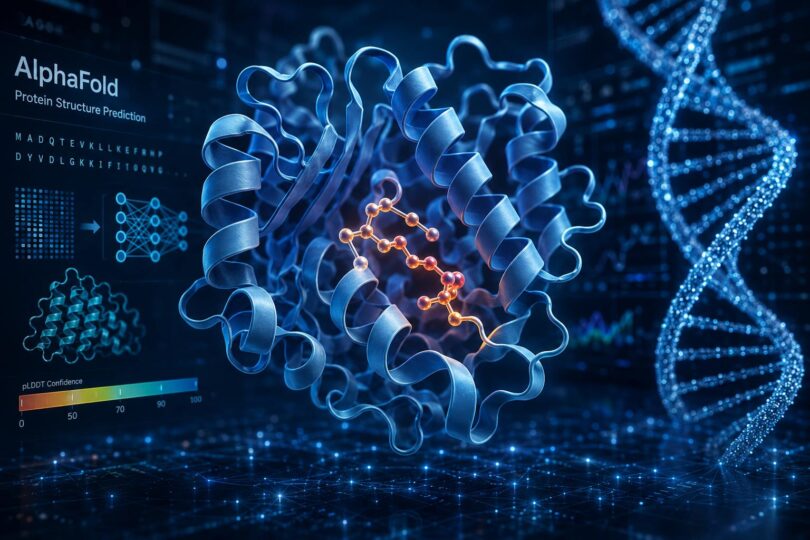
AlphaFold is an artificial intelligence system, developed by Google DeepMind, that predicts the three-dimensional structure of proteins from their amino-acid sequence with accuracy rivalling experiments. Because a protein’s shape determines its function and how drugs bind to it, AlphaFold solved a 50-year “grand challenge” of biology and has reshaped structural biology and drug discovery.
Who should read this? This guide is intended for pharmaceutical researchers, biotechnology professionals, laboratory scientists, drug discovery teams, investors, students, and anyone looking to understand how AI is transforming structural biology.
Proteins are the molecular machines of life, and what a protein does is dictated by how it folds into a specific 3D shape. For half a century, determining those shapes meant slow, costly laboratory experiments. AlphaFold changed that almost overnight: it can predict a structure in minutes, and its creators have released the predicted shapes of nearly every protein known to science.
Quick Navigation
- What is AlphaFold?
- The Protein Folding Problem
- How AlphaFold Works
- AlphaFold vs Experimental Methods
- AlphaFold2 vs AlphaFold3
- Applications in Drug Discovery
- Industry Implications
- Limitations
- Future Outlook & LSGN Perspective
- FAQs
At a Glance: Key Statistics
- ~50 years — how long the “protein folding problem” resisted solution before AlphaFold.
- 200 million+ — protein structures predicted and made freely available in the AlphaFold Protein Structure Database (DeepMind with EMBL-EBI).
- ~2020 — AlphaFold2’s breakthrough performance at the CASP14 structure-prediction contest, published in Nature (2021).
- 2024 — DeepMind’s Demis Hassabis and John Jumper share the Nobel Prize in Chemistry (with David Baker) for protein structure prediction and design.
- 2024 — AlphaFold3 launches, extending prediction to proteins interacting with DNA, RNA, small molecules and ions.
- Minutes vs months/years — AlphaFold prediction time versus traditional experimental structure determination.
Figures are indicative and drawn from the sources linked above; verify before publishing.
Key takeaways
- AlphaFold predicts protein structure from sequence — turning a problem that took years of lab work into a computation that takes minutes.
- Its open database of 200M+ structures put a near-complete map of the protein universe in every researcher’s hands, for free.
- It matters for drug discovery because structure guides how drugs are designed to bind a target.
- AlphaFold3 (2024) went beyond single proteins to model how they interact with other molecules — closer to how biology actually works.
- The achievement earned a 2024 Nobel Prize in Chemistry and spawned Isomorphic Labs, DeepMind’s drug-discovery company.
- It is a powerful predictor, not an oracle: outputs are models that still need experimental validation.
What is AlphaFold?
AlphaFold is a deep-learning system that reads a protein’s amino-acid sequence and predicts the 3D coordinates of its atoms. First demonstrated by Google DeepMind at the CASP14 contest in 2020 and detailed in Nature in 2021, it achieved accuracy that structural biologists had assumed was still years or decades away. In partnership with EMBL-EBI, DeepMind then released predicted structures for over 200 million proteins — effectively the entire catalogue known to science — for anyone to use freely.
Key takeaway: AlphaFold turned protein structure from a years-long experiment into a minutes-long computation.
The Protein Folding Problem
A protein starts as a chain of amino acids, but only becomes functional when it folds into a precise 3D shape. Predicting that shape from the sequence alone was famously hard: the number of possible configurations is astronomical (Levinthal’s paradox), yet proteins fold reliably in nature. Solving this “protein folding problem” — reliably going from sequence to structure by computation — was a goal biologists pursued for roughly 50 years, because knowing a protein’s shape unlocks understanding of its function, its role in disease, and how to target it with drugs.
Why this matters: structure is the bridge between a genome and a medicine. Without shapes, much of molecular biology and rational drug design is guesswork. That is why cracking this problem was significant enough to earn a Nobel Prize.
How AlphaFold Works
AlphaFold is trained on the ~200,000 experimentally determined structures in the Protein Data Bank, plus vast databases of protein sequences. In simplified terms, it:
- Takes an amino-acid sequence as input.
- Finds evolutionarily related sequences across species, whose patterns of co-variation hint at which parts of the protein sit close together.
- Uses a specialised attention-based neural network to reason jointly about the sequence and these spatial relationships.
- Outputs the predicted 3D coordinates of every atom — with a per-residue confidence score (pLDDT) telling researchers how much to trust each region.
Key takeaway: The confidence score is what makes AlphaFold a usable research tool rather than a black box.
AlphaFold vs Experimental Methods
| Dimension | Experimental (X-ray, cryo-EM, NMR) | AlphaFold prediction |
|---|---|---|
| Time per structure | Months to years | Minutes to hours |
| Cost | High (equipment, labour, samples) | Very low (compute) |
| Throughput | Limited | Effectively unlimited |
| Accuracy | Gold standard (experimental truth) | High for many proteins; a prediction, not proof |
| Best for | Definitive structures, novel/complex cases, dynamics | Rapid first structures, large-scale coverage, hypothesis generation |
| Key limitation | Slow, expensive, some proteins resist | Static snapshots; weaker on disorder, dynamics, novel folds |
Table: AlphaFold does not replace experiments — it complements them, providing a fast first model that experiments can confirm or refine.
AlphaFold2 vs AlphaFold3
| Feature | AlphaFold2 (2020) | AlphaFold3 (2024) |
|---|---|---|
| Predicts | Single protein structures | Proteins plus interactions with DNA, RNA, ligands, ions |
| Scope | The protein universe | Biomolecular complexes closer to real biology |
| Significance | Solved the folding problem | Models how molecules bind — central to drug design |
| Access | Open-source; 200M+ database | Via AlphaFold Server, with usage terms |
AlphaFold3, described in Nature in 2024, is the more consequential step for medicine: modelling a protein together with a candidate drug molecule is far closer to the question drug designers actually ask.
Applications in Drug Discovery
Most drugs work by binding to a target protein and changing its behaviour. Designing such a drug is far easier when you can see the target’s shape and the pockets a molecule might slot into. AlphaFold gives researchers a starting structure for targets that were previously unsolved, accelerating the earliest stages of drug design and opening up “undruggable” or understudied proteins. This is a foundational input to the broader field of AI in drug discovery, and it is why DeepMind spun out Isomorphic Labs to apply the technology commercially.
Key takeaway: AlphaFold has changed structural biology from a bottleneck into a starting point.
Industry Implications
AlphaFold effectively commoditised a capability — first-pass protein structures — that was once a scarce, specialist asset. That lowers barriers for smaller biotechs and academic labs and shifts competitive advantage toward what you do with structures: the quality of downstream design, experimental validation and proprietary data. It also reshapes the economics of structural biology itself, freeing experimental methods like cryo-EM to focus on the hardest, most valuable cases rather than routine determinations.
Limitations
- Static snapshots. AlphaFold predicts a structure, but proteins move; it does not capture dynamics or the full range of conformations.
- Disorder and novelty. Intrinsically disordered regions, and genuinely novel folds unlike anything in training data, are harder.
- Mutations and interactions. Predicting the precise effect of a single mutation, or fine details of binding, remains challenging even for AlphaFold3.
- Prediction ≠ proof. Outputs are models; high-stakes decisions still require experimental confirmation.
- Access and reproducibility. AlphaFold3’s terms differ from AlphaFold2’s fully open release, raising questions for commercial users.
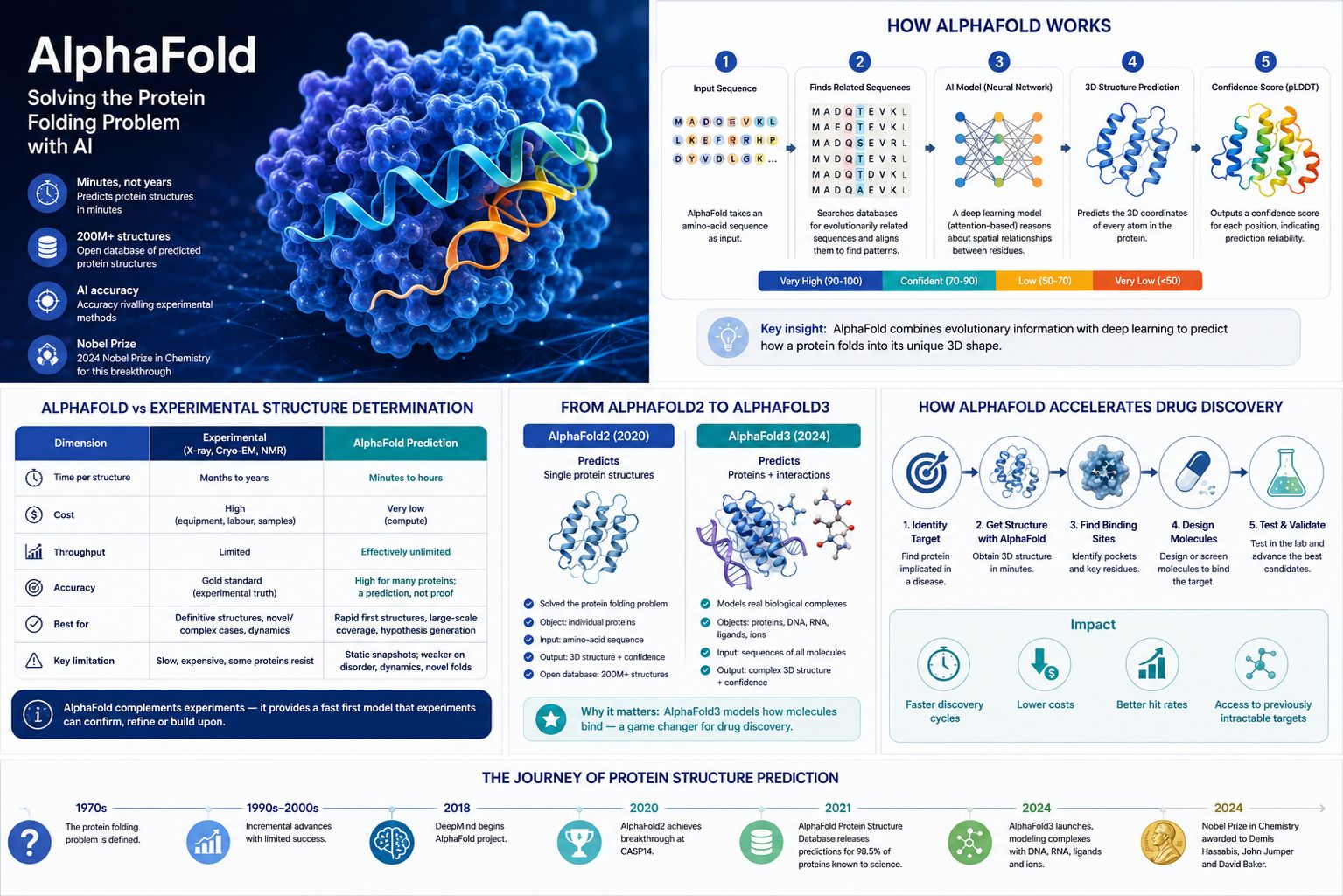
Comprehensive infographic illustrating how AlphaFold predicts protein structures, compares with traditional experimental methods, and supports AI-driven drug discovery.
Future Outlook & LSGN Perspective
Over the next three to five years, AlphaFold and its successors will become invisible infrastructure — the assumed starting point for any structural question, much as genome databases are today. The frontier is shifting from static structure to dynamics and interactions: predicting how proteins move, bind partners and respond to drugs. Expect a wave of competing and complementary models (from academic labs and companies alike), tighter integration with generative molecular design, and growing scrutiny of access terms and validation standards.
Key takeaway: Structure prediction is no longer the bottleneck or the moat; the durable advantage lies in experimental validation, proprietary data and the ability to turn a predicted structure into a real, approvable medicine.
AlphaFold opened the door — walking through it still takes rigorous science.
FAQs
What is AlphaFold in simple terms?
AlphaFold is an AI system from Google DeepMind that predicts the 3D shape of a protein from its amino-acid sequence, quickly and accurately — solving a problem biologists worked on for about 50 years.
Is AlphaFold accurate?
For many proteins it achieves accuracy comparable to experiments, and it provides a confidence score for each region so researchers know which parts to trust. It is a prediction, not a substitute for experimental confirmation in high-stakes work.
Is AlphaFold free to use?
AlphaFold2 is open-source and its database of 200M+ structures is freely available via EMBL-EBI. AlphaFold3 is accessible via the AlphaFold Server under specific usage terms, which differ for commercial use.
How is AlphaFold used in drug discovery?
It provides structural models of drug targets, helping researchers design molecules that bind them — accelerating early discovery and enabling work on previously unsolved proteins. AlphaFold3 can also model protein–molecule interactions.
What is the difference between AlphaFold2 and AlphaFold3?
AlphaFold2 predicts single protein structures; AlphaFold3 (2024) also predicts how proteins interact with DNA, RNA, small molecules and ions — closer to real biological systems.
Did AlphaFold win a Nobel Prize?
Yes. In 2024, DeepMind’s Demis Hassabis and John Jumper shared the Nobel Prize in Chemistry (with David Baker) for protein structure prediction and design.
Editor’s Note. AI in structural biology is advancing rapidly. This guide reflects the state of the field as of 2026 and will be updated by the LSGN editorial team as major developments emerge.