

Artificial intelligence is moving from experimental use case to core infrastructure across biotechnology.
For decades, biology moved at the pace of the wet lab: one hypothesis, one experiment and one result at a time. AI is changing that model by helping researchers predict protein structures, design molecules, analyse genomic data and prioritise experiments at a scale that would be difficult for human teams to manage manually.
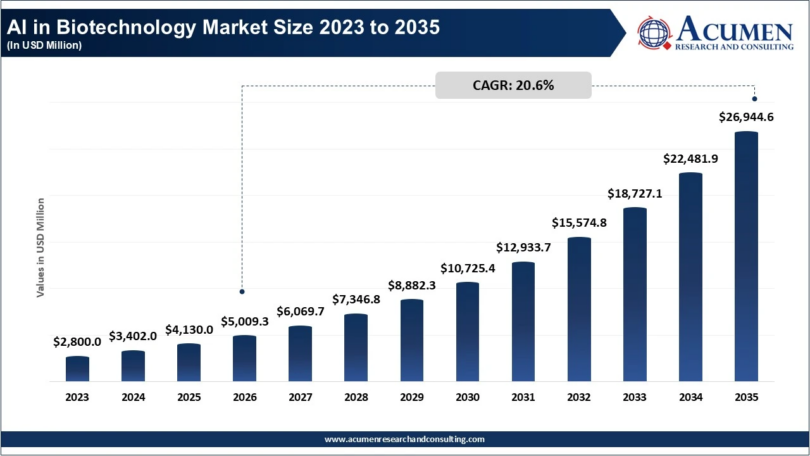
According to Acumen Research and Consulting, the global AI in biotechnology market was valued at USD 4.13 billion in 2025 and is forecast to reach around USD 26.94 billion by 2035, representing a compound annual growth rate of 20.6% from 2026 to 2035.
The figures reflect a wider change across research institutions, biotechnology companies and government laboratories, where AI is increasingly treated as part of the scientific operating model rather than a pilot project.
Protein design becomes a data problem
Protein engineering has always faced an enormous search-space problem. Even a relatively short protein can have more possible sequence combinations than any laboratory could test by conventional methods.
That is why high-throughput data generation has become central to AI-enabled biotechnology. In 2026, researchers publishing in Nature Biotechnology described Sequence Display, a method for generating large-scale protein sequence-activity datasets in a single experiment.
The work showed how detailed sequence-function maps can be combined with protein language models to accelerate protein evolution and discover optimised variants. In practical terms, that kind of data generation gives AI systems the labelled examples they need to train, predict and improve.
The importance of computational protein design was also recognised by the 2024 Nobel Prize in Chemistry, awarded to David Baker for computational protein design and to Demis Hassabis and John Jumper for protein structure prediction.
AI in biotechnology is no longer only about prediction. It is increasingly about connecting prediction, design, testing and learning into a faster research cycle.
Public funding follows AI-enabled biology
Government research agencies are also investing in the infrastructure needed to make AI in biotechnology more reliable and reproducible.
The US National Science Foundation has invested nearly USD 32 million through its Use-Inspired Acceleration of Protein Design initiative, supporting teams working to translate AI-based protein design into practical applications for the bioeconomy.
The US National Institutes of Health has also launched the Bridge2AI programme, a USD 130 million initiative intended to generate AI-ready biomedical and behavioural research datasets, tools, standards and training resources.
These investments suggest that public funding bodies now see AI-enabled biology as a strategic research capability, not only a software layer added to existing workflows.
AI tools enter everyday biotechnology workflows
The strongest signal of maturity is not market size, but experimental validation.
AI models are increasingly being used to support de novo protein design, antibody discovery, binding prediction, genomic analysis, drug discovery and precision medicine. Protein structure prediction tools are now among the most widely adopted AI applications in biotechnology, while docking, binding prediction and generative molecular design tools are moving through internal validation across the sector.
The next phase is the emergence of lab-in-the-loop systems. These connect computational design tools with automated wet labs, allowing predicted molecules or proteins to be synthesised, tested and fed back into the next model cycle.
This design-build-test-learn loop can compress research cycles that previously took months into far shorter experimental timelines, especially where automation, high-throughput assays and model retraining are integrated.
Regulation is becoming part of the AI biotechnology model
As AI moves deeper into biotechnology, regulation and governance are becoming more important.
Regulators are increasingly focused on whether AI systems are reliable, explainable, traceable and appropriate for their intended use. In biotechnology and pharmaceutical settings, AI may be involved in discovery, diagnostics, clinical development, manufacturing, quality control and post-market monitoring.
That means organisations need more than strong models. They need data governance, documentation, validation, human oversight and cybersecurity controls.
For companies using AI in sensitive healthcare or pharmaceutical workflows, the compliance question is becoming clearer: how can AI improve speed and decision-making without weakening accountability?
What the growth numbers point to next
The projected growth of the AI biotechnology market reflects several overlapping trends: larger biological datasets, better protein design methods, automated laboratories, stronger public funding and a maturing regulatory environment.
For biotechnology companies, the competitive advantage is likely to come from proprietary biological data, validated models, integrated laboratory infrastructure and clear governance.
The organisations best placed for the next decade will be those that treat AI as part of the scientific workflow, not as a separate digital experiment.
FAQs
What is AI in biotechnology?
AI in biotechnology refers to the use of machine learning, generative models and computational tools to support biological research, drug discovery, protein design, diagnostics, genomics and biomanufacturing.
How large is the AI in biotechnology market?
Acumen Research and Consulting estimates that the global AI in biotechnology market was valued at USD 4.13 billion in 2025 and could reach around USD 26.94 billion by 2035.
Why is AI important for protein design?
Protein design involves an enormous number of possible sequences. AI can help predict which sequences are most likely to produce useful structures or functions, reducing the number of experiments needed.
What is lab-in-the-loop biotechnology?
Lab-in-the-loop biotechnology connects AI-driven design with automated wet-lab testing, so experimental results can feed directly back into the next round of model training and design.
Why does regulation matter for AI in biotechnology?
AI tools used in life sciences must be reliable, traceable and governed appropriately, especially when they support drug development, diagnostics, manufacturing or quality decisions.